

CASE STUDY
Clutch Car Subscription
OVERVIEW
From 2014 to 2022, I led design for Clutch, the very first car subscription service. Beginning in 2014, as part of the original team of five, I helped prove the concept viable with a research-centric, highly iterative process that endured two rounds of funding and acquisition in 2018.
ROLE
Product designer, branding, product manager, user experience
Introduction
In the 1967 re-appraisal for his classic book Designing for People, Henry Dreyfuss wrote:
“We need a car to fit the daily commuter, but at the push of a button on the dashboard, it will expand to take care of the family on weekends.”
We need our car to change with our lives.
Fifty years later: Enter car subscription. In 2014, a small team at Kenzie Lane Innovation set out to test an idea. Will consumers give up the traditional idea of owning and financing a car and adopt access to a fleet of cars for a flat monthly payment?
THE CHALLENGE
Create an experience valuable enough to encourage car-buyers to pay a premium to subscribe instead.
Launching an MVP
I designed a simple marketing site (Figure 1) and a rudimentary iOS app (Figure 2). The website had one call to action: sign up via the iOS app.
Once in the app, a potential member could sign up, provide payment, and request a car delivery (called a “flip”). Using this website and app, we signed up our first fifty members and began observing.
To request a “flip”, a member would choose a body style, number of passengers, and time and location of the delivery. We found that 99% of flips would happen at home on Saturday or at the office during a weekday afternoon.
Research at this point was ad hoc and informal – discussions with members during flips (yes, I also delivered cars in the early days).

Figure 1: The first iteration of the Clutch car subscription marketing site. The only action is to download the member app.
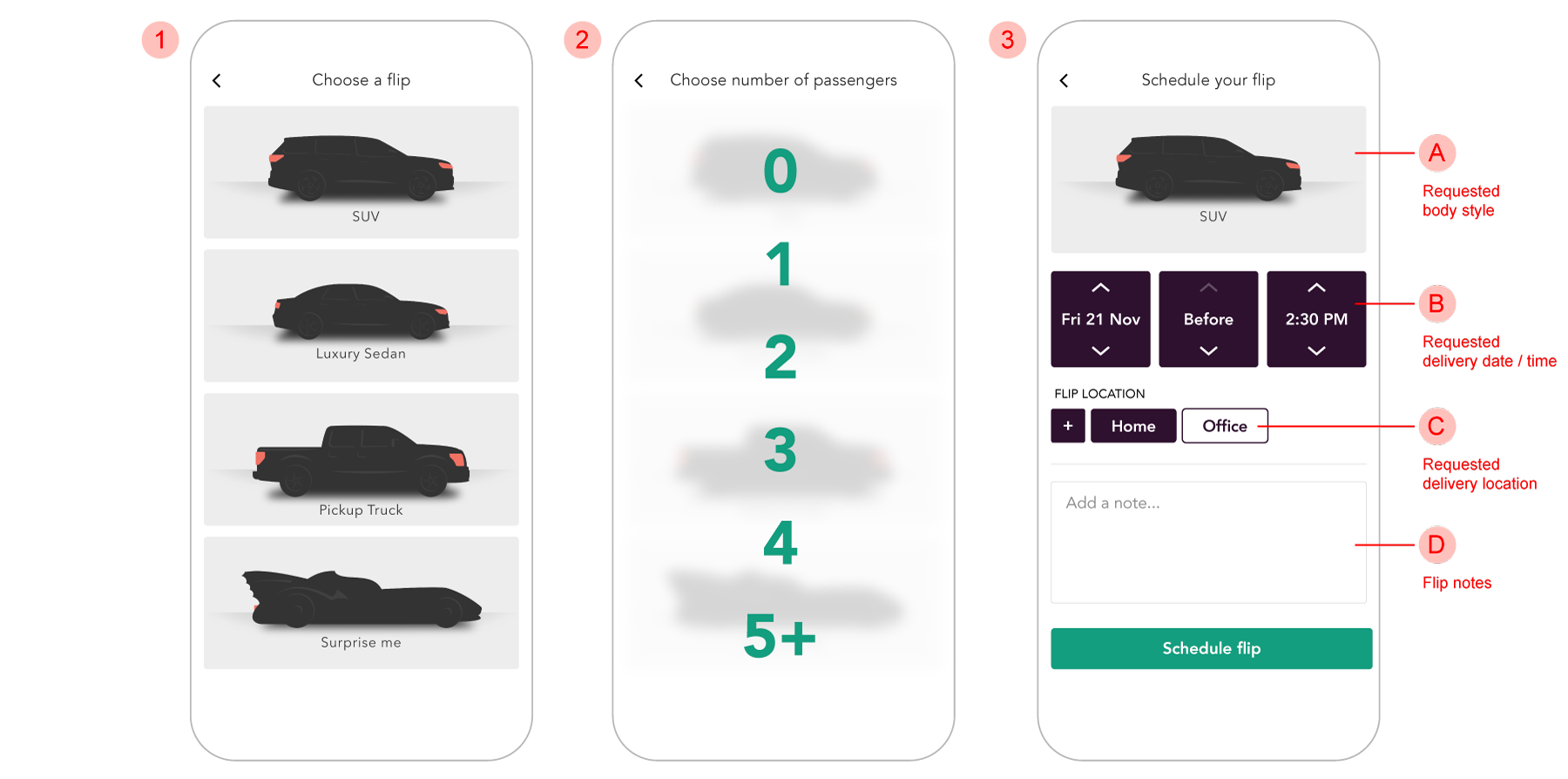
Figure 2: The first iteration of the member app core experience, requesting a car delivery (flip). To request a flip a member would choose a body style (1), number of passengers (2), and time and location of the delivery (3).
Iterating the core experience
Early versions of the member app allowed a member to choose a flip by body style (see A on Figure 3). This worked well for a member, but we soon learned everyone wanted a sedan on Monday and a truck on Friday. We ran into inventory issues.
Next, we created the concept of “recipes” (B). Members chose a use case, and we provided a car to match. This worked better for inventory but introduced some anxiety to the member. Imagine getting all dressed up for a special night out, and we deliver a convertible. So long, perfect coiffed hairdo.
To relieve some anxiety around delivering an unknown car, I added comments to a flip (C). A member would describe their use case and we, the car matching “experts”, would find the right ride. Less anxiety, but a bit friction-y.
In the years following the member app launch, the underlying technology got better at predicting availability. The app presents what car is likely to be available (D). This experience balances transparency for the member and flexibility of inventory. Learn and iterate.

Figure 3: The first version of the app (A) allows a member to choose a vehicle by body style, which led to inventory problems. Next version (B) had the member choose a use case instead which led to anxiety around receiving an unknown car . We added notes (C) which was too friction-y. Later version (D) struck a better balance of transparency for the member and flexibility of inventory.
Exploring the brand
In early interviews with our first fifty members (those ad hoc conversations during flips), a theme emerged. Members were taking special trips. Some would take the scenic route home from work. Some would drive 4 hours just to get good boiled peanuts. Members were making memories because they had a car that fit their need.
Special occasions, unlocked by having the right car for the right moment, would become the idea to build a brand on. Imagery focused on the moment, with members in focus. The cars were abstracted. New members received handwritten “thank you” notes, t-shirts, and playful sunglasses when flipping into a convertible.
I found that subscription is not the product. The product is the special moment.


Selling the story
We put forth a massive effort around selling this story. Working with a local student filmmaker, I art-directed a series of shorts focusing on the unique, human aspects of the service. I even produced a few videos on my own.
Then we tested the advertising. The goal with ads was to see what would get the user into the app or download the quickest. Advertising exploration was a rich exercise. Using Facebook and AdSense we targeted people likely in the market to buy a new car to offer them a new option - subscribe instead.
We were able to define three primary demographic groups and pick a piece of the subscription story that speaks to that group.
The three primary subscription demographic groups:
1) The Do-it-all Family
2) Empty Nesters
3) The Sales Professional


Outcome
With a 2+ year effort to build an engaging consumer experience around subscription we were able to gain 600+ subscribers, perform 5,000+ flips, maintain an >80 Net Promotor Score, and most importantly, sell the concept along with our learnings and service tools to dealerships who are now operating it at scale.